Eye Movement Desensitization and reprocessing
EMDR is a structured, evidence-based psychotherapy treatment that enables your brain heal from stuck, painful or traumatic memories and emotional distress that are a result of disturbing life experiences by helping clients activate their natural healing processes and removing “blocks” that have prevented healing. This is done through the use of detailed protocols and procedures that the clinician has learned through training.
Instead of just talking about an event, EMDR uses bilateral stimulation (i.e. side-to-side eye movements, alternating taps, or alternating auditory beeps) while you focus on a “target” (a memory and/or negative belief you have developed about yourself as a result of the experience(s)). The bilateral stimulation activates the neuropathways that hold the belief and the related experiences, allowing your brain to reprocess the event(s), resulting in the painful memories and beliefs to loosen, decreasing activation from them, and for space to open so a new, positive/adaptive belief can be installed in its place.
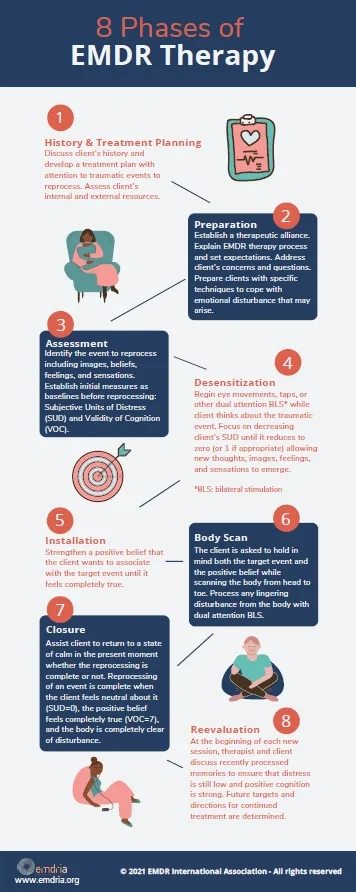
EMDR unfolds across 8 distinct phases to ensure you feel safe and in control:
History and Treatment Planning: Your therapist learns your background and the therapist and client collaboratively chooses specific target memories to focus on.
Preparation: Your therapist teaches you coping and calming tools to use if you feel overwhelmed. In EMDR terms, this is called “resourcing”.
Assessment: You choose a specific memory and identify the negative thoughts, feelings, and body sensations tied to it.
Desensitization: You focus on the memory while bilateral stimulation is implements (in the form of a moving ball on your computer screen, or alternating auditory sounds in your headphones, or tapping), letting your distress drop down.
Installation: You link a positive, helpful belief to replace the old negative belief about yourself.
Body Scan: You check your body to see if any tension or discomfort remains connected to the memory.
Closure: You bring your nervous system back to a calm, stable state before leaving the session.
Reevaluation: Your therapist checks your progress at the start of the next session to see if any gains held.
As bilateral stimulation methods are used, internal associations arise and the client begins to process the memory and disturbing feelings. In successful EMDR therapy, the meaning of painful events is transformed on an emotional level. Unlike talk therapy, the insights clients gain in EMDR therapy result not so much from clinical interpretation, but from the clients down accelerated intellectual and emotional processes.
Important to know:
You Are in Total Control: BLS is not hypnosis. You will remain fully awake, aware, and in the present moment the entire time.
The Stop Signal: You can pause the BLS at any second by simply raising your hand or saying "stop." We only move at your pace.
No Forced Talking: You do not need to describe every graphic detail of the trauma out loud for the BLS to do its job; your brain will do the heavy lifting internally.
EMDR is widely recognized by organizations such as, the American Psychiatric Association, the World Health Organization, and the Department for Defence, as an effective form of treatment for trauma and other disturbing experiences. It has been extensively researched and have resulted in more than 30 positive controlled outcome studies proving the efficacy of EMDR for the treatment of PTSD.
References used:
https://www.emdria.org/about-emdr-therapy/
https://pmc.ncbi.nlm.nih.gov/articles/PMC3122545/
https://www.emdria.org/about-emdr-therapy/experiencing-emdr-therapy/
https://www.youtube.com/watch?v=Pkfln-ZtWeY&t=15
https://www.emdria.org/resource/8-phases-of-emdr-therapy-infographic/
If you are interested in EMDR, or in learning more about whether EMDR is right for you, schedule a free 15-minute consultation call with me
How does bilateral stimulation work?
Bilateral stimulation (BLS) changes brain activity by physically shifting the nervous system out of a survival loop and forcing the brain to re-store traumatic memories in a non-threatening format. According to neuroimaging and clinical research summarized by organizations like EMDRIA, BLS acts as a neurological catalyst. It transitions the brain from an emotional, alarm-state reaction to an integrated, logical cognitive state. [1, 2, 3, 4, 5].
Neuroscientists highlight five primary mechanisms that explain how side-to-side eye movements, auditory tones, or tactile taps alter brain function:
1. Working Memory Taxing Theory
When a traumatic memory is recalled, it is highly vivid, emotionally charged, and occupies a vast amount of your brain's immediate "working memory" capacity. [1,2]
The Overload Effect: BLS serves as a second, competing task that also demands working memory space. [1,2,3,4]
Memory Degradation: Because the human working memory has a strictly limited capacity, it becomes overloaded by doing both tasks at once. [1, 2, 3, 4, 5]
The Result: The brain can no longer hold the trauma memory in its hyper-vivid state. As a result, the memory naturally degrades, losing its sharp emotional intensity and vividness. [1, 2]
2. Down-Regulating the Amygdala (The Threat Center)
In an un-reprocessed state, a trauma memory triggers the survival brain. [1]
The Overactive Amygdala: Recalling trauma triggers a spike in the amygdala, the brain's alarm system. This causes physical panic, flashbacks, and a fight-or-flight response.[1,2, 3]
The Analytical Shift: Functional MRI (fMRI) scans show that as rhythmic BLS continues, activity in the amygdala drops significantly. [1, 2]
The Prefrontal Boost: Simultaneously, activity increases in the prefrontal cortex (the rational, logical brain). This shift allows the brain to finally realize that the danger is in the past, and it is currently safe. [1, 2, 3]
3. Inter-Hemispheric Integration
Trauma often causes a communication breakdown between different regions of the brain. The raw sensory and emotional aspects of the memory are frequently isolated in the right hemisphere, disconnected from the language and contextual processing centres in the left hemisphere.[1, 2, 3, 4, 5]
Bridging the Hemispheres: Rhythmic, alternating left-to-right stimulation forces both hemispheres to activate sequentially. [1, 2]
Rerouting Neural Highways: This cross-talk coordinates communication between the hippocampus (the brain's time-stamping filing cabinet) and the cortex. [1]
The Result: The “stuck" emotional data is safely integrated with rational facts. The memory is filed away with a proper chronological context ("That happened then, but I am safe now"). [1, 2, 3]
4. Mimicking REM and Slow-Wave Sleep Processes
During normal sleep cycles, the brain naturally reorganizes, consolidates, and files away the day's experiences and memories. [1, 2]
Offline Processing: The rapid, ballistic eye movements used in EMDR closely mimic the natural saccadic eye movements that happen during Rapid Eye Movement (REM) sleep.
Memory Consolidation: EEG data suggests that active BLS reprocessing also mirrors slow-wave (deep) sleep brainwave states. Both sleep states are essential for memory consolidation. BLS intentionally triggers this innate, biological filing mechanism while you are fully awake and conscious. [1, 2]
5. Physical Growth and Repair in the Brain
Chronic stress and trauma release high levels of toxic stress hormones (like cortisol), which can actually shrink the tissue in your hippocampus over time, making it hard to file memories away.
The Change: Long-term structural MRI studies have shown that following successful EMDR therapy, the hippocampus actually demonstrates a measurable increase in physical volume. By clearing the toxic stress of the trauma, EMDR triggers neuroplasticity—giving your brain the biological safety it needs to physically heal, rebuild, and grow its memory-processing tissue.
The Somatic Bonus: Pro-Parasympathetic Activation
Beyond changing your cognitive pathways, BLS sends an immediate physical signal to your body. Clinical deconstruction studies show that rhythmic bilateral stimulation has a distinct pro-parasympathetic effect. It physically engages the vagus nerve to lower blood pressure, slow down an elevated heart rate, and increase heart rate variability. This baseline of physical relaxation makes it much safer and more tolerable for your mind to face distressing memories without becoming re-traumatized.
Helpful to Know
EMDR is not hypnosis, and it does not make you forget your past. Instead, it is an active, biological tool that helps your brain do what it always wanted to do: digest a painful experience, file it away as a closed chapter in your history book, and allow you to live fully in the present moment.
What to Expect Right After an emdr Session
EMDR does not stop working the moment you leave your session. Because EMDR kicks off a deep neurobiological filing process, your brain will continue to digest, sort, and process information for 24 to 48 hours after your session. You might notice new insights, vivid dreams, brief flashes of old memories, or a wave of physical tiredness. Think of this as your brain doing its metabolic "housecleaning."
Depending on how much time we had during our session, your post-session experience will generally fall into one of two categories:
Scenario A: A Completed Session
A session is considered "completed" when we have fully reprocessed a targeted memory during our time together, bringing your distress level down to neutral and successfully installing a positive, adaptive belief.
What it feels like after: You will likely experience a deep sense of relief, lightness, or a feeling that a heavy weight has finally been lifted. When you think of the memory, it will feel distant, like a blurry image from a movie you saw a long time ago.
What to do: Rest and give yourself permission to lay low. While the acute distress is gone, your nervous system is still integrating this massive shift and needs physical downtime to reset.
Scenario B: An Incomplete Session
Because trauma memories can be complex, it is very common to run out of time before a memory is fully processed. This is a completely normal part of the EMDR journey. Before you leave, we will always use a "containment exercise" to safely shelf the raw material until our next meeting.
What it feels like after: You may feel more emotionally sensitive, reactive, or physically fatigued than usual. Because the memory network was activated but not fully closed, your brain might try to keep processing the leftover pieces. You might feel "in-between" stages of healing.
What to do: This is the time to rely heavily on the grounding and self-soothing tools we practiced in Phase 2 (such as your Safe/Calm State visualization or Container exercise). Remind yourself: "The memory is activated because it is finally healing, but the actual danger is over. I am safe in the present moment." Keep a brief log of any insights or intense emotions that show up so we can target them first next time.
Additional Resources